
It stops at the login and calls you.
Do the login or 2FA yourself, then hand the tab back.
See the login handoffA visible desktop browser for coding agents, with a separate workspace for each project.
Hronaut installs on your computer, not your phone.
Narration: Your coding agent can write the feature. But to check it, it needs a browser. Should that be your everyday Chrome, with your email and your bank? Give it its own browser instead: Hronaut. A visible window, with a separate workspace for each project. When it reaches a login, it stops and calls you. You sign in. The agent never sees the password. Then you hand the tab back. Hronaut gives your agent real debugging tools: the page, the console, the network. So it can find what is broken. Run several agents at once. Each works in its own workspace, so they don’t step on each other. And they stay out of your everyday browser, so they don’t distract you or break your work there. One button mutes every tab. Another blocks your stray clicks and keys, while agents keep working. Give your coding agent its own browser. Keep yours.
On screen: Claude Code is asked to check the Orders page of a local example store admin. Hronaut already holds two workspaces from an earlier Claude Code run. Claude Code creates a third workspace, Acme Store, and opens the sign-in page. It asks for a person and waits, and the tab is marked Needs you. A person types a made-up password and code in the same tab and hands the tab back. Claude Code opens the Orders page in that signed-in session, reads the page, the console and the network requests with Hronaut’s tools, and reports that Revenue today reads $NaN. In a second recording, two Claude Code runs work at the same time, each in its own workspace: one checks a local docs site, the other a local landing page. Home lists both as working and shows what each is doing. While they work, a person presses Mute all tabs and then Block input in the tab rail, and both keep working.
Recorded on November 10, 2026 from an unmodified Hronaut source build with real Claude Code CLI runs. The terminal text is drawn from the run’s prompt and output, the two drawings of browser windows are illustrations, and the sign-in is sped up. No page plays sound in the recording, so the mute button is shown without an audible change. The person’s input is driven by the capture harness. The store admin, the docs site and the landing page are local pages; the account is made up. Not shown: the installer or an external website. The narration is a synthesized voice over original music; sound is optional. Download the video.
Or Watch the recorded reconnect check: a client disconnects, the page stays, and a new client explicitly resumes the workspace. Recorded with Hronaut, MCP test clients, and a local example page. See the exact scope.
Works with
Your tabs
Your everyday Chrome
Your email, your bank and the tab your agent works in share the same sign-ins.
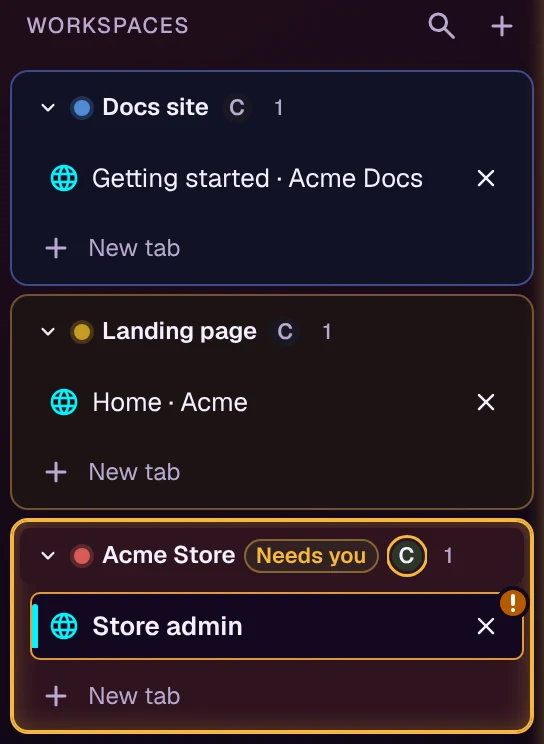 Real app capture · Example data
Hronaut
Agents work in Hronaut, not in the Chrome with your email and bank. They can use what you sign into in Hronaut.
See what an agent can reachDo the login or 2FA yourself, then hand the tab back.
See the login handoff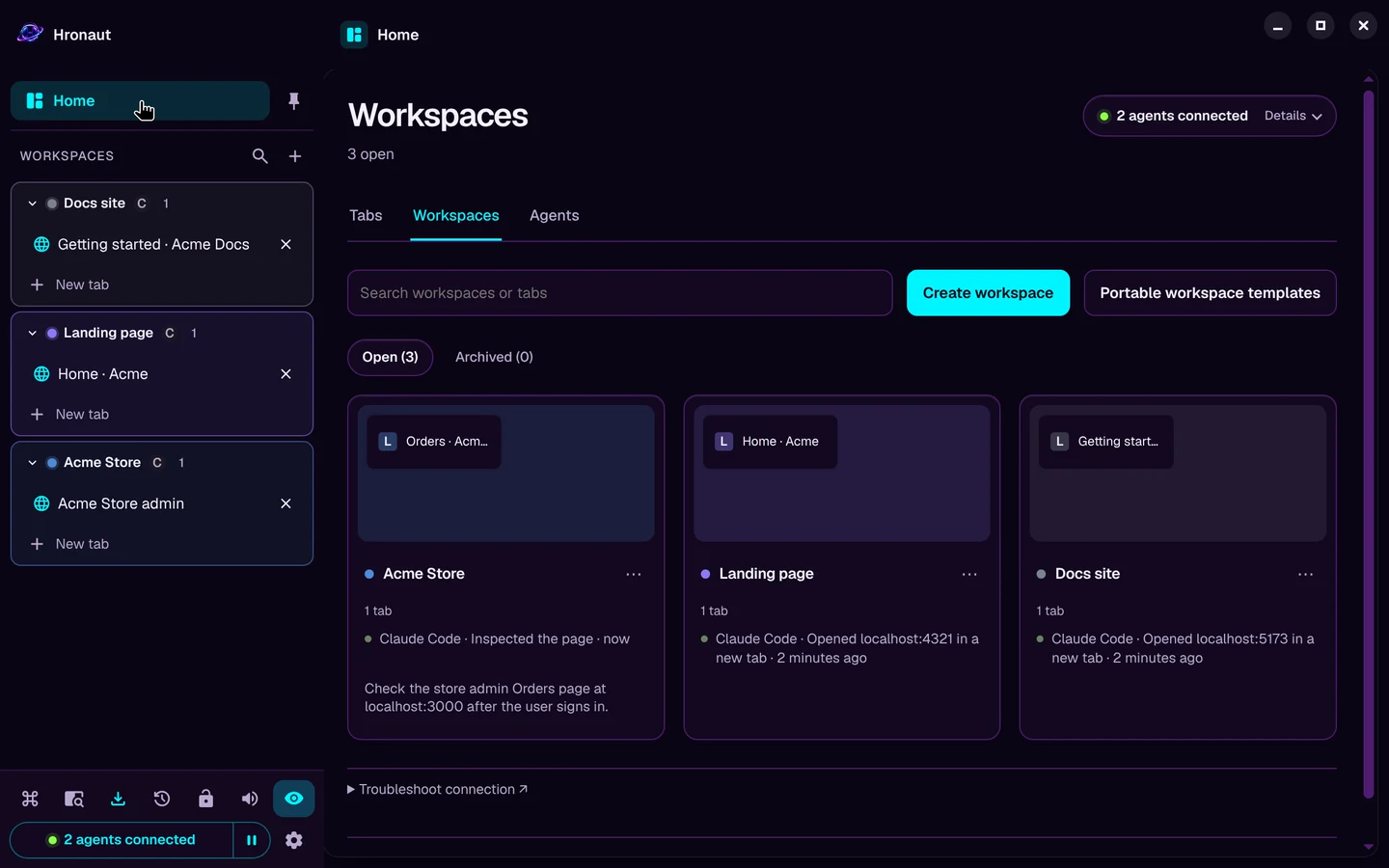
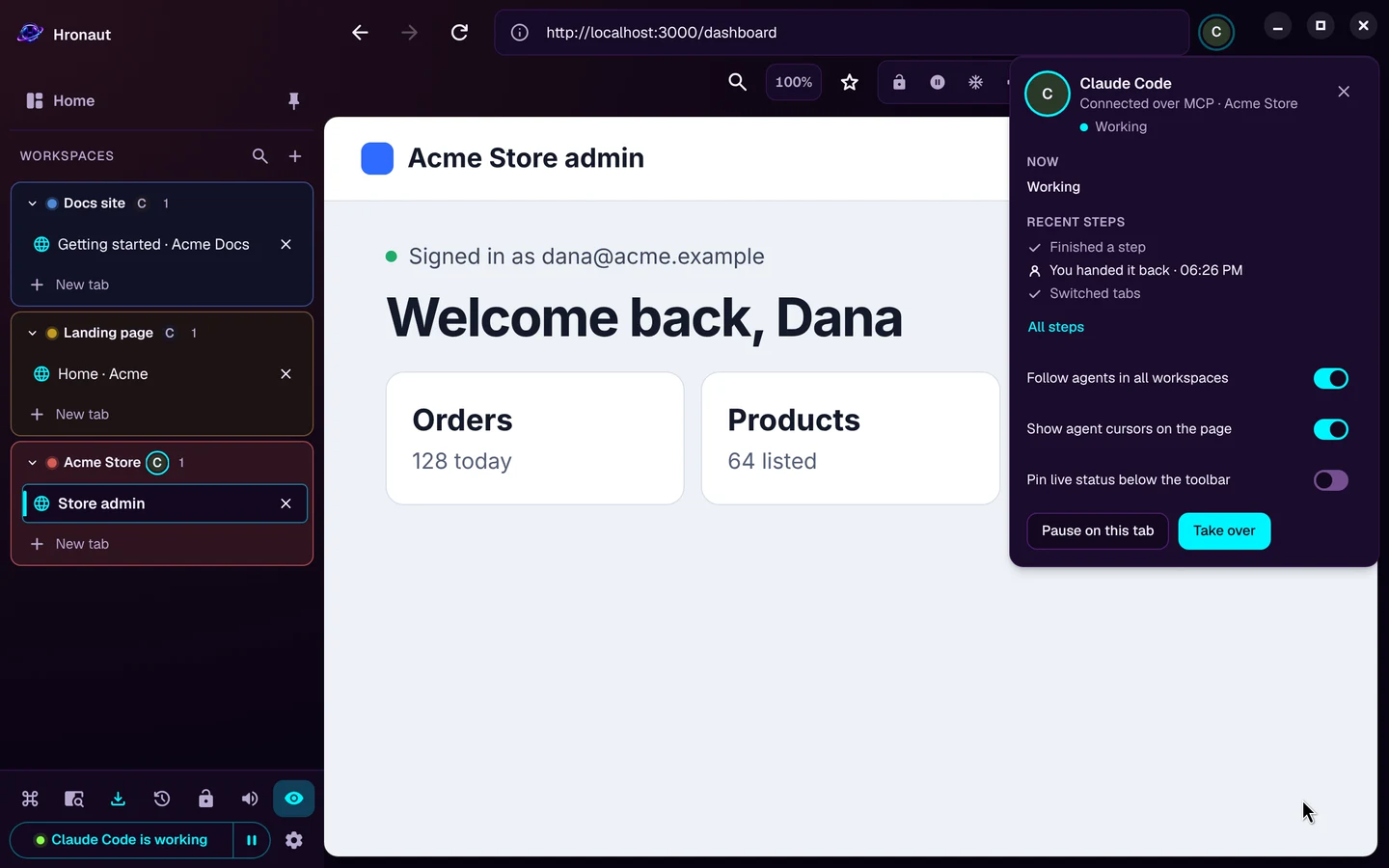
Windows, macOS and Linux.
Download Hronaut/plugin marketplace add hronaut/hronaut-claude-plugin
/plugin install hronaut@hronautcodex plugin marketplace add hronaut/hronaut-codex-plugin
codex plugin add hronaut@hronautcode --install-extension hronaut.hronaut“Open my local app in Hronaut and check that sign-in works.”
Try a localhost checkPricing and trial
Or $24 a year. All features, one named user, up to three devices.
10-day trial
10 consecutive days from your first agent tool call. No credit card required.
Subscription seat
Equivalent to $2/month, billed annually — 50% off $48.
1 seat · $24 / year before applicable tax
Renews automatically at $24/year until you cancel. Cancel anytime.
Secure Creem checkout is loading.
Source-available under the Hronaut Subscription and Trial License. All ongoing use requires a subscription after the trial. Hronaut's plugins and VS Code extension are MIT-licensed. Cancellation and refunds · Manage subscription
An immediate cancellation ends access immediately; end-of-period cancellation keeps access through the paid date. Cancellation does not request a refund. After expiry, agent automation stops; browser data remains accessible manually for recovery, export, and deletion. Read the refund policy.
Before you install
Bring your own coding agent, such as Codex, Claude Code, or Cursor. Your agent or model costs are separate. Choose your agent.
Yes. Open your local app or sign in inside a project workspace. Website sessions can expire; Hronaut does not bypass login or 2FA. Keep Hronaut and the agent connection running for automation.
The 10-day trial starts with your first agent tool call. It needs no card, and nothing is charged when it ends. All ongoing use requires a subscription, which renews automatically until you cancel. After expiry, automation stops and browser data remains accessible manually for recovery, export, and deletion.
Use every feature for 10 days; the trial needs no card and never charges you. Read all of Hronaut's source on GitHub. The Claude Code and Codex plugins and the VS Code extension are open source under the MIT License: copy, change, and ship them anywhere, even in paid products. Ongoing use of the app itself needs a subscription.
Yes, you can build it: see Run from source. Your own build has the same trial and subscription terms as a download. Issues, documentation suggestions, and private security reports are welcome. Code pull requests to the app are paused until we publish a contributor agreement; pull requests to the MIT plugins and extension are welcome now.
Subscriptions fund the work a desktop browser needs: Chromium security updates, regular releases for Windows, macOS, and Linux, and support. You can still read every line to audit what runs on your computer, and the parts that connect your agent to Hronaut are MIT.
Profiles stay on your computer. Websites receive normal browser traffic, and your agent can receive page contents. If that agent uses a cloud model, its data handling applies. Read the security boundary.
Initial packages are not platform code-signed or Apple-notarized. Verify published hashes and GitHub attestations before installing. Verification steps · Get help.
| Question | Playwright MCP | Chrome DevTools MCP · Browser MCP | Hronaut |
|---|---|---|---|
| Whose browser | A managed automation browser | Your everyday Chrome | A separate desktop app |
| Where sign-ins live | A project profile | Your live Chrome profile | A named workspace per project |
| Best for | Repeatable automation and tests | Debugging in the Chrome you have open | Recurring signed-in checks across projects |
Other tools can keep sessions too. Free tools are the right choice for CI or a quick debug. Read the full comparison →
Other computers need your explicit opt-in.
Every site runs in Chromium’s sandbox.
Watch every step and take over when you want.
Checksums and GitHub build attestations for every package.
A connected agent is trusted with the visible browser session. See exactly what is isolated and what is not →
Latest releaseWindows, macOS, and Linux packages with SHA-256 hashes and GitHub build attestations.The skill guides isolated workspaces, semantic browser actions, and private human handoff. It does not install Hronaut, configure MCP, or contain secrets.
npx skills add hronaut/hronaut --skill hronaut10-day trial from your first agent tool call. No credit card required.